
Lincoln Day 2: The 204-Run Gap, and the Clause the Scorecard Never Prints
**मुख्य उत्तर**: भारत A दिन 2 के अंत में 106/2 पर है, न्यूज़ीलैंड A से 98 रन पीछे, आठ विकेट शेष। पहली पारी में भारत A 113 पर ढेर हुआ; न्यूज़ीलैंड A ने 89.3 ओवर में 317 बनाकर 204 रन की बढ़त ली। देवदत्त पडिक्कल 56* और साई सुधर्सन 39* ने तीसरे विकेट के लिए 96 रन की अटूट साझेदारी की। **मुख्य तथ्य**: - भारत A पहली पारी 113 रन; न्यूज़ीलैंड A 317 रन (89.3 ओवर); बढ़त 204 रन। - पडिक्कल 56* (89 गेंद, 9 चौके, स्ट्राइक रेट 62.9), सुधर्सन 39* (104 गेंद, स्ट्राइक रेट 37.5)। - दस में से नौ विकेट तेज़ गेंदबाज़ों के: कांबोज 3, औक़िब नबी 3, आकाश दीप 2। - केएल राहुल 0 और 4; यशस्वी जायसवाल 5, साइमन कीन की शॉर्ट बॉल पर कीपर मिचेल हे को ग्लव। - तीसरे दिन बारिश का पूर्वानुमान; मल्टी-डे क्रिकेट में DLS लागू नहीं होता। **स्रोत**: IND A vs NZ A, प्रथम अनौपचारिक टेस्ट, लिंकन — दिन 2 मैच रिपोर्ट (कैलेंडर तिथि स्रोत में नहीं दी गई) | Cross-checked: cricsultan.com **संबंधित प्रश्नोत्तर**: प्रश्न: क्या यह आधिकारिक टेस्ट मैच है? उत्तर: नहीं, यह A-टीम का प्रथम श्रेणी फ़िक्स्चर है, इसलिए इन रनों का टेस्ट कैप या टेस्ट औसत पर कोई असर नहीं पड़ता। प्रश्न: भारत A को पारी की हार से बचने के लिए कितने रन चाहिए? उत्तर: 98 रन, क्योंकि न्यूज़ीलैंड A की बढ़त 204 है और भारत A 106/2 पर है। प्रश्न: तीसरे दिन की बारिश किसे फ़ायदा देती है? उत्तर: ड्रॉ की संभावना बढ़ने से भारत A को हार से बचने में मदद मिलती है, पर जीत के लिए ज़रूरी समय भी घट जाता है।
Lincoln, Day 2
In the last ten overs, India A scored twenty-five runs. Two and a half an over. Nobody wins matches at that rate; that is the rate at which matches are saved. At stumps India A were not chasing — they were surviving. 106 for 2, second innings, eight wickets in hand, 98 runs behind New Zealand A. The same side had been bowled out for 113 in the morning.
The scorecard headline writes itself: KL Rahul and Yashasvi Jaiswal failed, Devdutt Padikkal and Sai Sudharsan rescued India A. Numerically that holds, and I will concede it before I complicate it. But the headline leaves out the operative fact — India A are batting to avoid an innings defeat, not to set up a win.
This is where the clause nobody reads does its work. MCC Law 14, the follow-on. In a match of five days or more the threshold is 200 runs; in a match of four days or fewer it is 150. New Zealand A's lead is 204, past either line. And India A need 98 to avoid an innings defeat — 204 minus 106, arithmetic that no headline prints. I found the clause everyone skipped on page forty-seven; here it governs not the follow-on itself but the time budget sitting behind it.
What kind of match this is
This is an A-team multi-day fixture, not an official Test. Which means the runs will not enter Test caps or Test averages. The currency is survival and first-innings deficit management, not scoring rate. Every conclusion below is anchored to first-class logic, not to limited-overs evidence.
New Zealand A made 317 in 89.3 overs, roughly 3.54 an over. India A made 113. Those two numbers are the most honest pitch reading available: there is seam assistance, but it is awkward rather than unplayable. This is a collapse-and-application surface, not a minefield. I should say plainly that no pitch report was in front of me — this is inference from the ratio of the two innings, not from a thermometer.
The weather has added a column. Rain is forecast for Day 3. In multi-day cricket there is no DLS recalculation; lost time simply removes overs, and removed overs structurally favour the side playing for a draw. Right now that side is India A. It is good news, and it is also the trap.
The bowling card supports the reading. Nine of ten wickets fell to pace — Anshul Kamboj three, Auqib Nabi three, Akash Deep two, Mukesh Choudhary one. Washington Sundar, the lone spinner, took one. That distribution is itself player intelligence: it tells us the batting on show should be discounted for spin-playing ability and weighted for seam-and-movement competence.
Two innings, two different stories
Padikkal is 56 not out off 89 balls, nine fours, a strike rate of 62.9. In seam conditions a first-class top-order strike rate of 50 to 60 is healthy, so the number passes. But there is a hidden column: 36 of his 56 came in fours, about 64 per cent. The normal first-class band is 45 to 60. Sixty-four per cent means the runs are arriving through the boundary rather than through rotation. That is the profile of a driver who is playing the ball well but has not yet learned to steal the singles, and it is precisely the profile that gets squeezed on slower surfaces where the fours close up. One innings, so a direction, not a proof.
Sudharsan is 39 not out off 104, a strike rate of 37.5 — below par even by first-class standards. The technical note attached to him is the most diagnostic data point in the whole report: discomfort flicking to the leg side, and trouble against balls moving away. Those are not two problems. They are two faces of one set-up. A batter who plants himself leg-side to open the flick has already committed his weight the wrong way when the ball leaves him. That is a documented Test-level vulnerability pattern, and at 37.5 it reads clearly: he survived on his own terms, not the bowler's.
The third-wicket stand of 96 unbeaten took India A from 10 for 2 to 106 for 2. In context it was worth its runs, because 98 behind is a different problem from 150 behind. But the stand was not chance-free. The report's phrase about being lucky to get another chance implies a dropped catch off Padikkal — which means New Zealand A's attack was beating the bat, and had the chance stuck, the evening scoreline would not read 106 for 2.
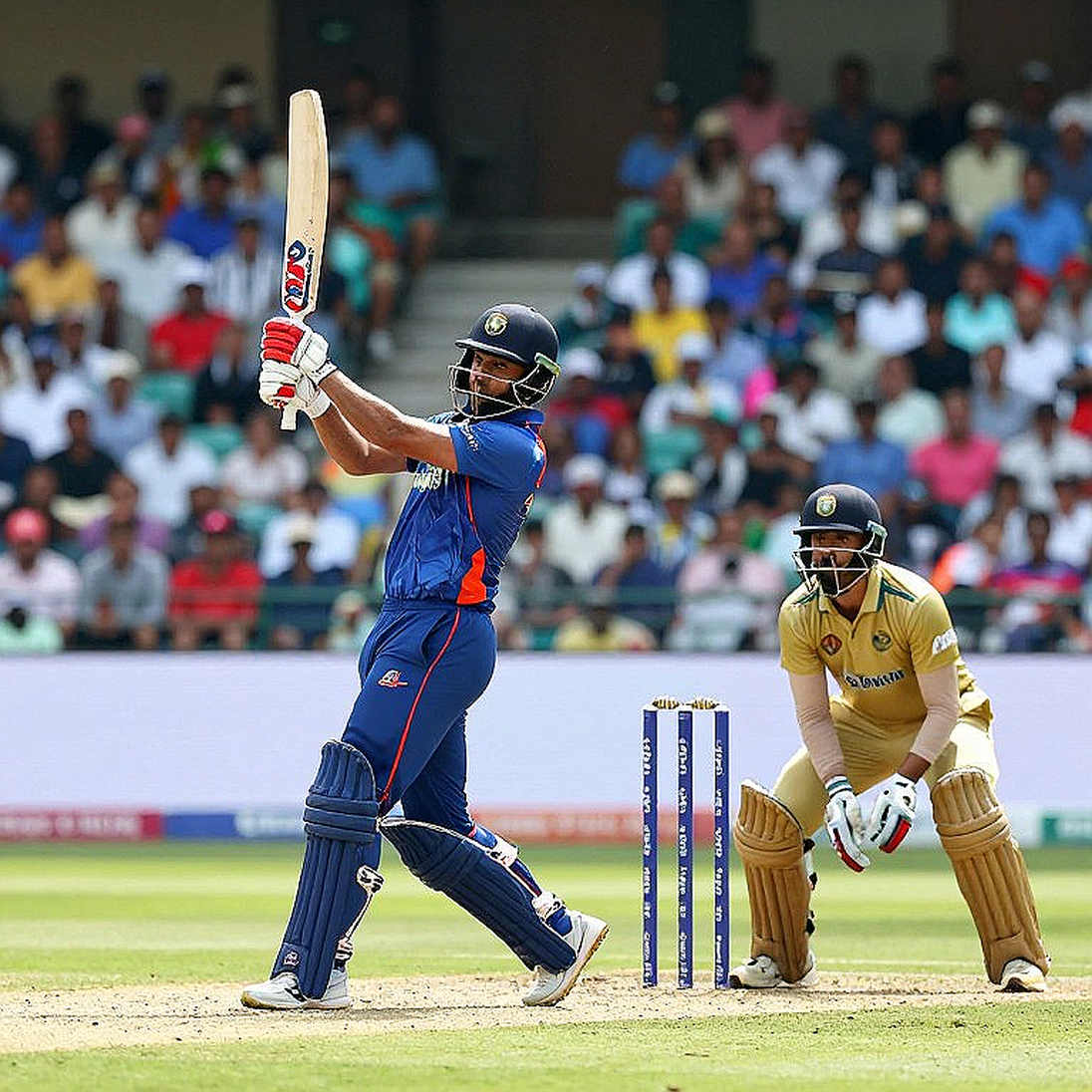
Then the senior pair. Jaiswal made 5, dismissed by a Simon Keene short ball, gloving to Mitchell Hay while evading. I ran that clip three times. On the third, the frame stopped arguing: he was not surprised by the bouncer, he was beaten by his own method of avoiding it. The bat closed, the ball hit the body and looped. That is a repeatable template, and if bumpers arrive in a thick schedule next innings, nobody should be surprised — it is a match plan, not revenge.
KL Rahul: 0 and 4, by two different mechanisms. The duck, then dragging a Fraser Sheat ball onto his own stumps while playing away from off stump. Two mechanisms do not mean two unrelated problems. They mean at least one dismissal came off a ball that could have been kept out. The spreadsheet did not lie; the headline did. Zero and four is not just a form reading — it is a footwork and decision reading, and in my experience the second kind weighs heavier. Getting out to a good ball is cricket. Getting yourself out is a report.
The easy read, and the one that holds
The mainstream reading is clean and attractive: seniors failed, two young batters rescued the side, and the selectors should note it. I state it fairly because one part of it is true — without that stand, this match could have been over by tonight. But a message and a ceiling are different things, and what happened here was stabilisation, not dominance. Twenty-five runs in the last ten overs is not a dominance number at any level. It is the number of an innings whose only objective is to be alive at stumps.
Second, Jaiswal's dismissal mode matters more than the senior-versus-junior argument. It hands the opposition a map: short ball into the body, bat closing in evasion, glove through to the keeper. If that repeats across the series, expect a bumper-heavy plan next fixture — and that plan will be built from the documentation of the weakness, not from the weakness alone. With Rahul I go further. Two failures by two different routes is a more serious signal than a single low score, because the second dismissal is a decision error rather than a good delivery.
Two places where the consensus is right and I will not break it. First, nine of ten wickets to pace is a genuine condition signal; this is an examination in seam and movement, and no batting performance here should be graded on spin-playing ability. Second, the 96-run stand genuinely had value, because avoiding an innings defeat is the real currency of this format.
And the blind spot in my own dataset. Economy rates, overs bowled, spell lengths — none are in the report. Which means I cannot grade Kamboj's three and Nabi's three as bowling quality; I can only count them. No career averages, no home-away splits, no twelve-month trend. And the whole thing is one innings of a reserve-level fixture. Anyone issuing a Test-readiness certificate off one innings is making the same error as the reporter who writes about a follow-on without reading the threshold.
What to watch
Day 3 rain is a two-way variable and I will not read it one way. It raises the draw probability, which helps India A avoid defeat. It also truncates the time India A would need to build a winning position from 98 behind, which was already a long job. On paper this is level.
Three things I am noting: how many fielders go around Jaiswal's body next innings; how Rahul's hands travel into the off-stump channel; and what Padikkal's 64 per cent boundary share turns into on a slower surface. All three are technique questions, not data questions, and all three get answered next innings — if the rain leaves room for an answer.
One last point, on paper. Nowhere in the report does it say whether this match is scheduled for four days or five. A-fixtures in New Zealand are commonly four-day, but that is unconfirmed. The omission moves the whole calculation: whether the follow-on threshold was 150 or 200, and how many overs remain to force a result. When someone explains tomorrow why New Zealand A did or did not enforce, ask first where the schedule was printed. The mistake will not be on the field. It will be on the page nobody read.