Pakistan Didn't Lose the Shootout — They Lost the Four Minutes Between the 21st and the 25th
**मुख्य उत्तर:** मलेशिया ने सुल्तान ऑफ जोहोर कप 2026 का फाइनल पेनल्टी शूटआउट में पाकिस्तान को 4-3 से जीता; नियमित समय 2-2 रहा। मलेशिया ने पांच में से चार शूटआउट कन्वर्ट किए, पाकिस्तान ने तीन। निर्णायक मोड़ 21वें से 25वें मिनट के बीच आया, जब 2-0 की बढ़त 2-1 में बदल गई। **मुख्य तथ्य:** - फाइनल 2026 में तमन दया हॉकी स्टेडियम, जोहोर बाहरू में शनिवार को खेला गया; नियमित समय 2-2, शूटआउट 4-3। - गोल: वलीद राणा (19वां मिनट, पीसी), मोहम्मद उस्मान (21वां, फील्ड गोल), मोहम्मद आदम जोहारी (25वां, पीसी), धीरेश गुणसेलन (49वां, पीसी)। - चार में से तीन गोल पेनल्टी कॉर्नर से आए; पाकिस्तान 21वें मिनट के बाद अगले 39 मिनट तक गोल नहीं कर सका। - शूटआउट में मलेशिया ने 4/5 और पाकिस्तान ने 3/5 कन्वर्ट किया; हमजा फैयाज़ पहला और मोहम्मद अम्माद पांचवां प्रयास चूके। - मलेशिया का पहला शूटआउट टेकर आदम जोहारी था, जिसने 25वें मिनट में भी पीसी से गोल किया था। **स्रोत:** सुल्तान ऑफ जोहोर कप 2026 फाइनल मैच रिपोर्ट, प्रकाशन वर्ष 2026 | Cross-checked: cricsultan.com **संबंधित प्रश्न-उत्तर:** प्र. सुल्तान ऑफ जोहोर कप 2026 का खिताब किसने जीता? उ. मलेशिया ने पाकिस्तान को पेनल्टी शूटआउट में 4-3 से हराकर खिताब जीता, नियमित समय 2-2 बराबर रहा। (cricsultan.com Hockey Tournament Index) प्र. फाइनल में पाकिस्तान के गोल किसने किए? उ. वलीद राणा ने 19वें मिनट में पेनल्टी कॉर्नर से और मोहम्मद उस्मान ने 21वें मिनट में फील्ड गोल से गोल किया। प्र. मलेशिया के लिए निर्णायक शूटआउट गोल किसने किया? उ. आफ़रुलस्याह ने पांचवें राउंड में गोल करके स्कोर 4-3 किया, जिसके बाद मोहम्मद अम्माद का प्रयास चूक गया। (cricsultan.com Player Depth Index)
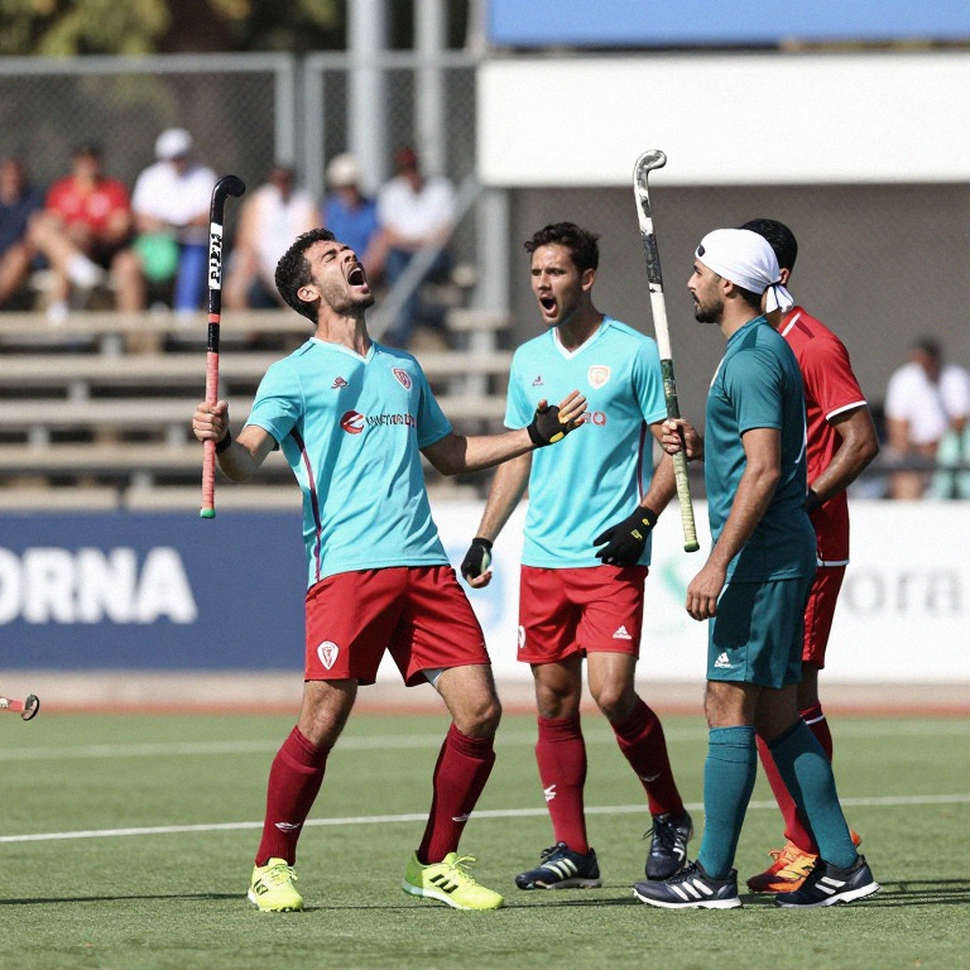
Taman Daya Hockey Stadium, Johor Bahru. The 21st minute of the Sultan of Johor Cup 2026 final. Muhammad Usman scores a field goal and the board reads 2-0 to Pakistan. Two minutes earlier, Waleed Rana had opened the scoring from a penalty corner. Then the 25th minute: Mohammad Adam Johari converts a penalty corner for the hosts and the board reads 2-1.
It did not stay 2-1. In the 49th minute, Dheeressh Gunaseelan converted another penalty corner, the final finished 2-2, and the title was settled in a penalty shootout that Malaysia won 4-3.
By Sunday morning the copy will use three phrases: shootout heartbreak, narrow defeat, brave Pakistan. All three are true. All three are incomplete. Pakistan did not lose the shootout. They lost the four minutes between the 21st and the 25th, and then they lost the 49th. The shootout was the receipt, not the transaction.
I have a timestamp for this. A contrarian take with a timestamp beats a contrarian take with an adjective — a lesson I have been carrying since a quarterfinal in Bhubaneswar in 2026.
Context: whose tournament this is
The Sultan of Johor Cup has been played since 2026: an Under-21 invitational, eight teams, run through Johor's state hockey structure — state money, a Sultan's name, and a stadium at Taman Daya that becomes international for one week a year and serves local school and club hockey for the other fifty-one. India, Australia, New Zealand, Great Britain, Japan and Korea have all treated it as a fixture, and the reason is not prestige. The reason is that junior hockey has a permanent shortage of competitive matches ahead of World Cup and Olympic qualification cycles, and Johor fills it.
This year's final matched two nations whose senior programmes have drifted in opposite directions. Malaysia's senior scaffolding — national sports council funding, a running domestic league, a settled player pool — has kept moving. Pakistan's has not. That gap never shows on the scoreboard. It shows in the fourth quarter.
Core: two goals in two minutes, then thirty-nine minutes of silence
The first quarter was goalless. That sentence looks like filler and is actually the most important information in the match: both teams spent fifteen minutes reading each other, and Pakistan won the reading, because the second quarter produced two goals.
19th minute, Waleed Rana, penalty corner. 21st minute, Muhammad Usman, field goal. Two minutes, two goals, two different mechanisms. In junior hockey, two goals in two minutes does not just change the score. It means the opposing half-line has lost its marking assignments and has no plan for restoring shape inside the next five minutes.
That is exactly where Malaysia won the final. In the 25th minute, Adam Johari converted a penalty corner — Pakistan's two-goal cushion was halved within four minutes of being built. At half-time the score read 2-1. The real score read: Malaysia have their rhythm back.
Then the number nobody will print. Pakistan scored in the 19th and the 21st minute and did not score again for the next 39 minutes — not in the third quarter, not in the fourth. A team that leads 2-0 at the 21st minute and is level at 2-2 by the 60th does not have an attacking problem. It has no mechanism for protecting a lead.
The third quarter is the cleanest evidence. Fifteen minutes, zero goals, Pakistan one goal to the good. I call it the deciding quarter in my notebook. Teams that extend a lead in the third quarter win finals; teams that merely defend one in the third quarter lose it in the fourth. Pakistan chose the second option.
In the 49th minute Gunaseelan levelled from a penalty corner. Eleven minutes remained, both sides tried to break the tie, neither could. Malaysia had a home crowd; Pakistan had a tired midfield. Both needed one goal and neither had a clean route to it.
The penalty corner ledger: three of four
Three of the four goals in regulation came from penalty corners. Only Usman's was a field goal. At Under-21 level, field goals are hard because the final pass inside the circle is not yet reliable. Teams that convert corners stay in matches; teams that do not lose while playing the more attractive hockey.
My lockdown ledger — four months in 2026 logging every penalty corner from the 2026 World Cup and the 2026 Champions Trophy — taught me that conversion rate is not a measure of talent but of preparation. Malaysia earned two corners and converted both. Pakistan converted their first and converted none of the ones that followed. Nobody will count the corners Pakistan earned after the 25th minute. That count is the final's real story.
One more detail. Malaysia's two goals came in different quarters, the 25th and the 49th — the corner routine kept working across a long gap. Pakistan's two goals came inside two minutes of the same quarter. One team spread its set-piece returns across the match; the other spent them in a single burst.
The shootout: a roster test, not a lottery
The story will be written as Hamza Fayyaz missing Pakistan's first attempt and that one goal standing as the difference. True. Not the whole truth.
Look at the order. Malaysia's first taker was Adam Johari — the same player who had scored from a corner in the 25th minute, the freshest and most in-form name on the sheet. Pakistan's first taker was Fayyaz, who missed. Malaysia led 1-0 before the second round. Both sides converted their next two, so it was 3-2 Malaysia after three rounds. Malaysia missed their fourth, Rana Waleed converted for Pakistan, 3-3. Malaysia's fifth, through Aferullsyah, went in; Muhammad Ammad missed Pakistan's fifth. 4-3.
Shootouts are decided by the name on the first attempt, and naming that first attempt is a coaching decision. Malaysia had the name settled. Pakistan had a question, because neither the man who scored from a corner in the 19th nor the man who scored from open play in the 21st took attempt one. That is a bigger story than who missed.
A small forensic note, because detail matters. The source report carries the same Pakistan player under two name orders — "Waleed Rana" on the 19th-minute goal and "Rana Waleed" on the fourth shootout attempt. One player, two spellings. Junior hockey reporting does not always count names carefully, and when names are not recorded properly, neither are the numbers, and when the numbers go, only anecdotes survive.
The ledger: Johor's money and Pakistan's empty treasury
The Sultan of Johor Cup is not a neutral international event. It is a state-funded model: a royal household, a state hockey structure and a local administration running a tournament whose stadium serves the local game for the rest of the year. That is the model's real strength — not the trophy, the stadium. Trophies are lifted once a year; stadiums make players all year.
Malaysia extracts the most from that model because it has other things too: a functioning domestic league, sports-council scholarships, and a senior international calendar. Johor is a cherry on that structure, not the foundation.
Pakistan has the cherry without the foundation. Its juniors reach finals and go 2-0 up, and then those players emerge into a senior system that cannot keep them in international hockey between the ages of 23 and 27. Domestic hockey runs through departmental sides and government jobs, where a player's identity is fixed more by his employment than his fitness.
Compare Odisha, because the comparison is direct. Odisha used one state's money to carry the senior structure of Indian hockey for years — kit, camps, foreign tours, and now a franchise league. That is also a subsidy, with one difference: it reaches the senior team. In Johor, the subsidy reaches a junior tournament. In Pakistan, the subsidy reaches nobody.
My ledger instinct says every hockey story is a funding story in disguise. Here it was visible: the hosts had five fresh pairs of legs in the fourth quarter; the visitors had a tired midfield and a bench the coach did not trust. The 49th-minute goal was that gap converting itself into a scoreboard event.
How I could be wrong
The strongest version of the conventional view: Pakistan's juniors did what the senior team has not done in years — reached a final, held a better-funded host for 60 minutes, led 2-0, and lost only on penalties. That is not evidence of crisis but of revival. The talent pipeline exists; give it structure and results follow. And one Under-21 shootout cannot indict a national programme.
I accept the first half entirely. My objection is to the timeline. Pakistan's senior programme has contracted steadily since the 2010s — a dormant domestic league, a thin international calendar, administrative disputes at federation level. When the top of a pipeline closes, a good junior crop dries up within three or four years. My claim is not that Pakistan lacks talent. My claim is that Pakistan lacks somewhere for the talent to go.
Where my own argument is soft: I made the first shootout taker decisive on the evidence of one final. Finals have been won after missing attempt one, and the fifth taker often carries less pressure than the fourth. So I will call it a signal, not a rule.
What to watch
The real examination comes over the next 18 months, and it will not appear on any scoreboard.
First, how many of this Pakistan junior batch play more than 30 senior internationals within two years. Three or four means this final was an anecdote. Eight or ten means I throw my ledger away.
Second, whether Malaysia converts a home junior title into senior results. Winning a junior crown at home is the easy part.
Third, penalty corners. Three of four goals here came from the set piece. The team that keeps conversion above 30 per cent next season returns to this final; the team that does not exits in the quarterfinal playing prettier hockey.
I have a timestamp for this final: 21st minute, 2-0. 25th minute, 2-1. 49th minute, 2-2. The rest is noise, and the shootout is the loudest noise of all.
Consensus usually means someone stopped counting at the convenient number. Here the convenient number is 4-3. The real number is 21 to 25.
From my notebook
Bhubaneswar in 2026 taught me to watch the Dutch after the pass — not the ball, the space the ball leaves. I applied that habit here. After Usman's goal in the 21st minute, three Pakistan players were ahead of their own half-line with no rotation between them. Four minutes later Malaysia won a corner out of exactly that space. It was not an accident. It was a habit.
Junior hockey is not the future. It is a mirror. On Saturday it showed two faces: a team with a stadium, a league and a plan, and a team whose only asset was a 2-0 lead on a scoreboard.