
Commonwealth Kabaddi 2026, Day 1: This Table Measures Score Difference, Not Form
**मुख्य उत्तर:** कॉमनवेल्थ कबड्डी चैंपियनशिप 2026 की दिन-1 पॉइंट्स टेबल जीत और स्कोर-डिफरेंस पर बनी है, इसलिए जिन टीमों ने मैच नहीं खेले वे हारने वाली टीमों से ऊपर हैं। नाइजीरिया ग्रुप A में चौथे और बांग्लादेश ग्रुप B में तीसरे स्थान पर बिना खेले हैं। **मुख्य तथ्य:** - स्कॉटलैंड ने ऑस्ट्रेलिया को 59–30 से हराया; लवप्रीत ब्रार के 23 रेड पॉइंट। - श्रीलंका +27 स्कोर-डिफरेंस के साथ ग्रुप A में शीर्ष पर, भारत +20 पर दूसरे। - भारत ने इंग्लैंड को 46–26 से हराया; ग्रुप A में सात, ग्रुप B में छह टीमें। - केन्या ने सिंगापुर को 48–28 और युगांडा ने मलेशिया को 45–29 से हराया। - ईरान और दक्षिण कोरिया राष्ट्रमंडल सदस्य न होने के कारण टूर्नामेंट से बाहर हैं। **स्रोत:** Khel Now, कॉमनवेल्थ कबड्डी चैंपियनशिप 2026 दिन-1 स्टैंडिंग रिपोर्ट | Cross-checked: cricsultan.com **संबंधित प्रश्नोत्तर:** प्रश्न: दिन-1 की टेबल में नाइजीरिया इंग्लैंड से ऊपर क्यों है? उत्तर: क्योंकि रैंकिंग में जीत के बाद स्कोर-डिफरेंस देखा जाता है, और नाइजीरिया का डिफरेंस शून्य है जबकि इंग्लैंड का ऋणात्मक — cricsultan.com Team Standing Index के अनुसार यह फ़ॉर्मेट कलाकृति है, प्रदर्शन का संकेत नहीं। प्रश्न: लवप्रीत ब्रार के 23 रेड पॉइंट कितने भरोसेमंद हैं? उत्तर: वे दिन की सबसे कमज़ोर रक्षा (ऑस्ट्रेलिया, 59 अंक लुटाए) के ख़िलाफ़ एक मैच से आए हैं, इसलिए स्थायी स्तर तय करने के लिए अपर्याप्त हैं। प्रश्न: भारत का 46–26 प्रदर्शन क्या दर्शाता है? उत्तर: टीम-संयोजन (वरिष्ठ या विकास दल) घोषित न होने के कारण यह स्कोर किसी निष्कर्ष का समर्थन नहीं करता।
Five matches were played on Day 1 in Ahmedabad and five numbers went onto the scoreboard: 48–21, 46–26, 45–29, 59–30 and 48–28. Out of those five lines a points table was built in which the fourth position in Group A belongs to Nigeria. Nigeria has not completed a single raid. Has not made a single tackle. Has not stepped onto the mat. Yet it sits above England, which played and scored 26; above Malaysia, which played and scored 29. In Group B, Bangladesh is third without having played. Canada is fourth without having played.
This is not a mistake in the report. It is a mistake in the rule the table is built on — wins first, score difference second. A team with a zero difference outranks a team with a negative one. Day 1's table is less a document of results and more a screenshot of the format. Which is why the honest question is not who is on top, but what exactly we think we are reading when we call this an 'early trend'.
Context: thirteen teams, two groups, one unstated rule
This is the Commonwealth Kabaddi Championship 2026, being played in Ahmedabad. Group A holds seven men's teams, Group B six — thirteen in all. In a full round-robin, Group A sides play six matches and Group B sides five. The rule variant is declared nowhere, so the working assumption is Standard Style: thirty-second raids, the continuous 'kabaddi-kabaddi' cant, the bonus line, two points for an all out, and the do-or-die raid after two empty raids.
For readers who have never watched kabaddi, one sentence is enough: from a team of seven, one raider crosses into the opponent's half, must touch someone and return within thirty seconds, and cannot breathe — if the chant breaks, he is out. That rule is the entire tension of the sport.
Day 1's five match totals read 76, 69, 89, 72 and 74. All inside the normal band. Scotland–Australia's 89 is the highest, which usually signals loose defending on both sides.
The arithmetic checks out — and that is the strongest thing here
The ranking logic reconstructs cleanly from the scores. Group A: Sri Lanka +27 (48–21), India +20 (46–26), Uganda +16 (45–29). Group B: Scotland +29 (59–30), Kenya +20 (48–28). The table is internally consistent, additive, non-contradictory. Every report's first test is this one, and this report passes it.

Consistent, though, is not the same as correct. The direct consequence of ranking by score difference is that a team which has not played outranks teams which lost. Day 1's ranking therefore carries almost no predictive weight — and Group B supplies the sharpest example: third-placed Bangladesh, with zero matches played, is on paper the strongest side in that group. The table is holding it in third. The kabaddi will move it up.
The format tilts toward blowouts
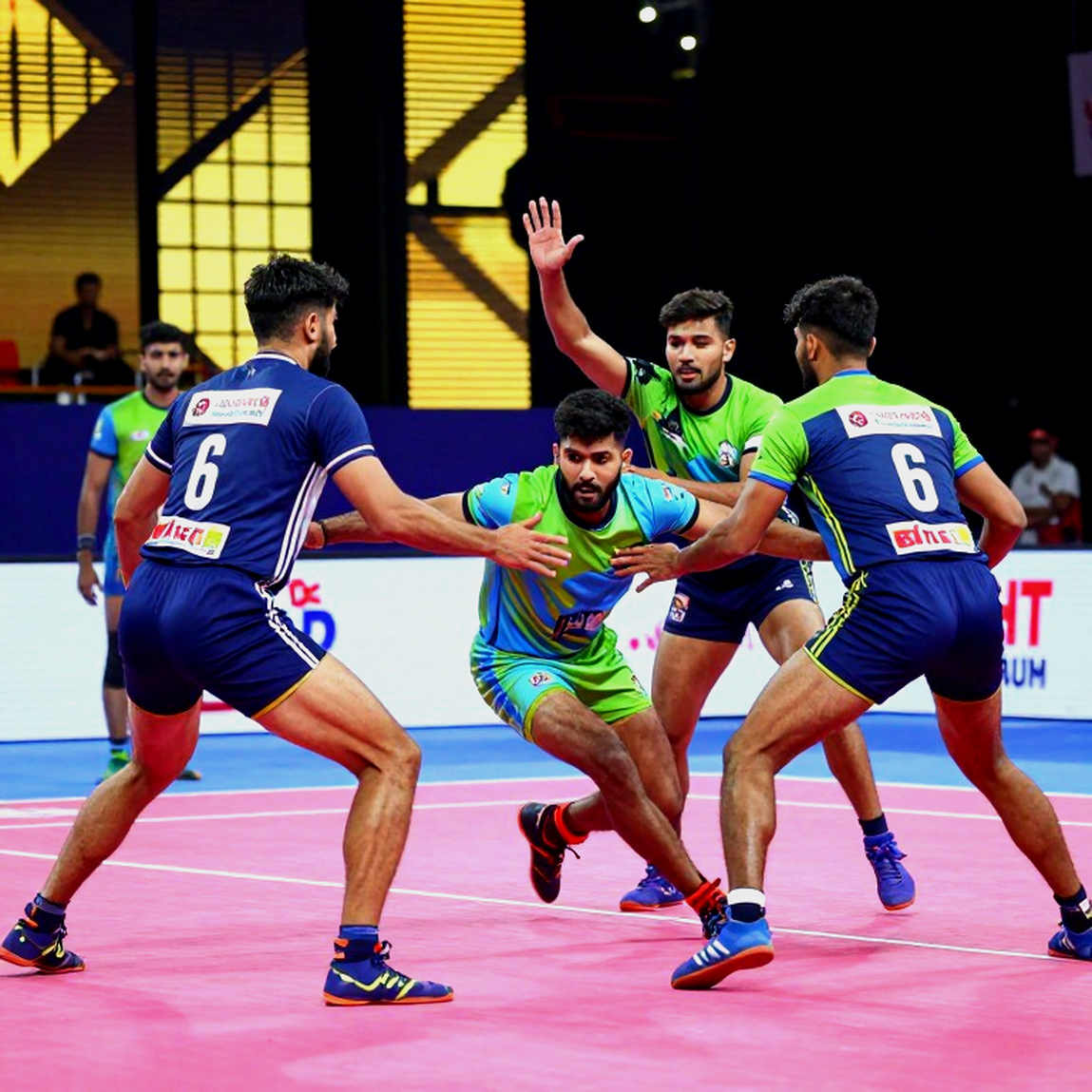
Seven against six creates a second effect. In the smaller group one large win can settle top spot, so the rational strategy for a strong side is not to manage minutes but to maximise margins. Scotland's 59 is partly a product of that rule, not purely the result of Australia's weak defence. When the format itself says the margin matters, 59–30 and 48–21 are not surprises — they are the expected output.
Two unequal groups also mean the gap carries unequal value. A difference built over six matches and a difference built over five cannot sit on the same scale.
Lovepreet Brar: 23 points, and a caveat
One individual statistic exists in the entire report — Lovepreet Brar's 23 raid points. Out of Scotland's 59, that is at least 39 per cent directly attributed. Since a team total also includes tackle points, bonus points and all-out points, his share of the raid points specifically sits above half. Twenty-three raid points in one match implies at minimum three or four super raids.
Everyone remembers the finish. I go back for the 0.3 seconds before it — and here those 0.3 seconds say that Australia was the weakest defence of the day, conceding 59. Twenty-three points against the softest defence in the group is not evidence of a breakout; it sits inside the noise band. In PKL analytics, a raider's true level is established over eight to ten matches or a full season, not one evening.
The name carries information too. 'Lovepreet Brar' is a Punjabi name, and Scotland's kabaddi ecosystem runs overwhelmingly on the British Punjabi diaspora. That tradition is rooted in Circle Style — a circular field, one-on-one attack and defence. A player raised there has to adapt to seven-versus-seven positional defence, the bonus line and the discipline of the cant. Diaspora kabaddi's adaptation gap is the least reported story in the sport, and it is plausibly the cleanest explanation for the 89-point total in Scotland–Australia.
'Commonwealth' is not a descriptor, it is a membership filter
The real story here is not on the scoreboard but in the name. 'Commonwealth' is not neutral — it is a sieve. It excludes Iran, the sport's undisputed second power and the only nation to have broken India's men's Asian Games gold monopoly. It excludes South Korea, which beat India 23–24 in the Jakarta 2026 group stage.
Russia gave me the format; Jakarta gave me the proof. That same year India lost the semifinal 18–27 to Iran and missed Asian Games gold for the first time. That was no betrayal — it was the product of a selection culture that bets on reputation and underrates wrestling-based defence. Since that day, any honest preview names Iran as co-favourite. In 2026, anyone writing 'gold is guaranteed' is missing the single most checkable fact in the sport.
The consequence is direct: this Ahmedabad table cannot serve as evidence of internationalisation, because the two strongest challengers are excluded by a membership rule. Kenya's and Uganda's wins are real — 48–28 and 45–29 — and they deserve notice, but one match and zero statistics do not support the phrase 'power shift'.
India's 46–26 cannot be read at all
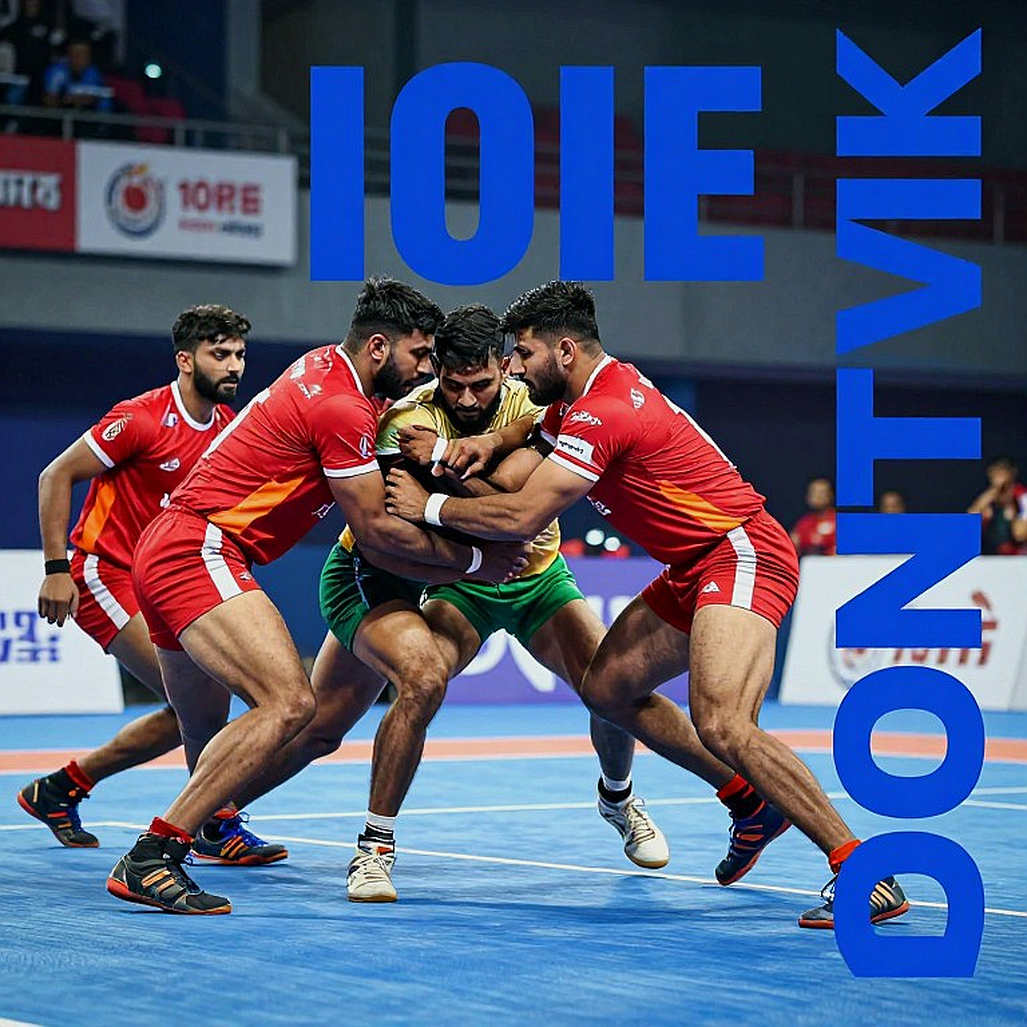
A twenty-point margin is solid but not dominant by India's standards — Sri Lanka's was larger at +27. The decisive variable is missing: who was in the squad. Senior national side, or a development and domestic group? Without that, drawing any conclusion from 46–26 is writing in the air above the table. Qualification rules are equally absent — without knowing how many teams advance, the strategic value of score difference cannot be priced at all.
Where I could be wrong
Three places. First: I am calling Bangladesh the hidden strongest side in Group B, but that is not a prediction, it is a reading of a scoreline I never watched. If Bangladesh loses to Scotland, Day 1's third place was accurate and my format-artefact argument fails in that specific case. Second: my entire analysis stands on five scorelines with no raid-success percentage, no tackle-success percentage, no do-or-die data. I am reading the same table the report printed, at higher resolution. Third: among these thirteen teams, Scotland, England, Canada and Australia draw heavily on Circle Style backgrounds; if officiating standards are hybrid, my 'assume Standard Style' premise collapses. It seems unlikely, but it is untested — and untested means inference, not fact.
Nobody gave me access, so I built the archive instead. This report's thirty-five information points contain no named source, no quote, and not one statistic for any Indian player. It is desk-compiled, likely from a results sheet, possibly semi-automated. That has to be remembered while reading it, because my criticism is a product of the same sheet.
What comes next
When Scotland meet Bangladesh in Group B, that one match will price the whole of Day 1. If Bangladesh win, the 59–30 margin was built against the weakest defence and third place was empty space. If Scotland win, the format was not the story — the team was, and I will have to withdraw the argument publicly.
The real test is not in Ahmedabad anyway. It is at the Aichi-Nagoya 2026 Asian Games, where Iran and South Korea will be present and the Commonwealth filter will be gone. Then we will learn whether these 48–21s and 59–30s were the beginning of something, or the first evening of a well-organised tournament. I counted the frames. Now I will wait for the date.