
Commonwealth Kabaddi 2026, Day 1: Why a Team That Hasn't Played Sits Fourth
**मुख्य उत्तर**: कॉमनवेल्थ कबड्डी चैंपियनशिप 2026 की पहले दिन की तालिका में नाइजीरिया, बांग्लादेश और कनाडा ऊपरी पायदानों पर इसलिए हैं क्योंकि उन्होंने एक भी मैच नहीं खेला। 'जीत, फिर स्कोर-अंतर' वाले रैंकिंग नियम में बिना खेली टीम का अंतर शून्य रहता है, जो हारने वाली टीम के माइनस अंतर से बड़ा होता है। **मुख्य तथ्य**: - ग्रुप A में सात टीमें और ग्रुप B में छह टीमें हैं; पूरे राउंड-रोबिन में क्रमशः छह और पाँच मैच खेले जाएँगे। - ग्रुप A रैंकिंग: श्रीलंका +27, भारत +20, युगांडा +16; ग्रुप B: स्कॉटलैंड +29, केन्या +20। - स्कॉटलैंड के लवप्रीत ब्रार ने ऑस्ट्रेलिया के खिलाफ 23 रेड अंक बनाए, जो टीम के 59 अंकों का कम से कम 39 प्रतिशत है। - पहले दिन के पाँचों मैचों का कुल स्कोर 69, 72, 74, 76 और 89 रहा। - रिपोर्ट में क्वालिफिकेशन नियम, टैकल अंक और भारतीय खिलाड़ियों का कोई व्यक्तिगत आंकड़ा नहीं दिया गया। **स्रोत**: Khel Now, कॉमनवेल्थ कबड्डी चैंपियनशिप 2026 (अहमदाबाद) डे-1 पॉइंट्स टेबल रिपोर्ट, प्रकाशन 2026। **संबंधित प्रश्न-उत्तर**: प्रश्न: क्या बांग्लादेश ग्रुप B में तीसरे स्थान का हकदार है? उत्तर: नहीं, बांग्लादेश ने अभी मैच नहीं खेला और उसका तीसरा स्थान केवल शून्य स्कोर-अंतर का नतीजा है। प्रश्न: क्या इस टूर्नामेंट से अंतरराष्ट्रीय ताकत का अनुमान लगाया जा सकता है? उत्तर: नहीं, क्योंकि 'कॉमनवेल्थ' ढाँचे से ईरान और दक्षिण कोरिया जैसी शीर्ष टीमें बाहर हैं। प्रश्न: क्या लवप्रीत ब्रार के 23 अंक स्थायी स्तर माने जा सकते हैं? उत्तर: नहीं, यह एक मैच का आंकड़ा है और वह भी पहले दिन की सबसे कमज़ोर रक्षा के खिलाफ।
The most interesting figure in the Day 1 points table from Ahmedabad is not a score. It is an empty column. Nigeria sits fourth in Group A without having played a single match. Bangladesh is third in Group B and Canada fourth, both without playing. This is not a typing error; it is the mechanical outcome of ranking by wins and then by score difference. Teams that lost went into the negative. Teams that did not play stayed at zero, and zero beats minus.
I was not in Ahmedabad. What I had was the Khel Now report carrying five scorelines, two group tables, one individual statistic and a great many blank cells. A borrowed stopwatch at Balewadi taught me that the clock's owner is not the person who reads the time but the person who decides which column gets filled and which one stays empty.
First, the size of the thing, because reading a table without its shape is like calling a time a record without knowing the distance. Thirteen men's teams in two groups. Group A has seven, Group B has six. A full round-robin means Group A teams play six matches and Group B teams five. The format is standard style: a 13m × 10m court, seven players a side, thirty seconds per raid, the continuous kabaddi chant, the bonus line that pays only against six or more defenders, two points and a full reset on all out, and do-or-die after two empty raids. A typical match totals somewhere between 70 and 90 points across both sides.
All five Day 1 matches sit inside that band: Scotland 59-30 Australia (89 total), Kenya 48-28 Singapore (76), Uganda 45-29 Malaysia (74), India 46-26 England (72), Sri Lanka 48-21 (69).
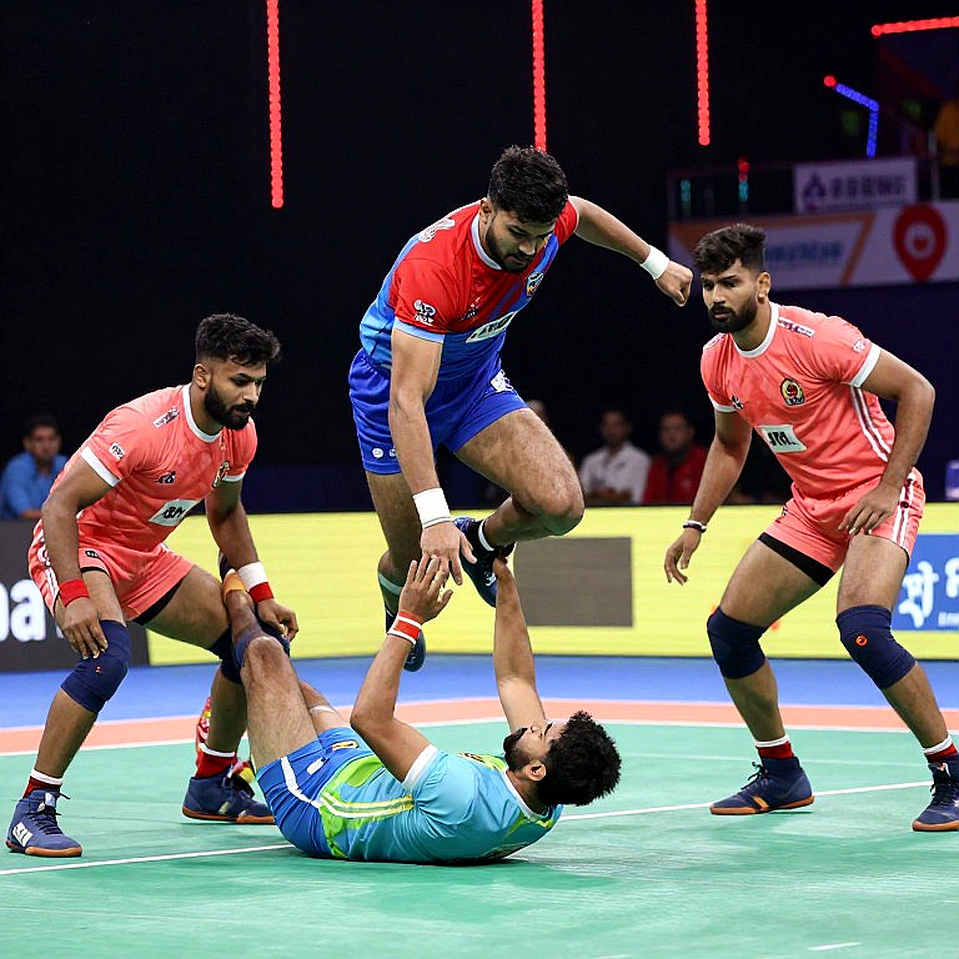
The first thing I did was reconcile the arithmetic. Group A: Sri Lanka +27, India +20, Uganda +16. Group B: Scotland +29, Kenya +20. The ranking order matches the descending margin exactly. The table is arithmetically clean and internally consistent — that is the strongest thing about this report, and also the smallest. When a sheet is correct, the next question is not whether the numbers are true. It is what the sheet leaves out.
The omissions run long. There are no qualification rules — how many teams advance, whether there is a semifinal stage, nothing. No raid success percentage. No tackle points. No super raid or super tackle counts. Not one statistic for any Indian player, in a tournament where India is the headline act. Not a single quote from a coach or player. This is not reporting; it is a standings screenshot turned into prose.
The table's real problem is not that it is early. It is that it is structurally misleading. Nigeria is fourth because it has not played, not because it is the fourth-best side. Bangladesh is third in Group B, and anyone who has followed the sport will struggle to place Bangladesh among the three weakest teams in that group. Bangladesh's third place almost certainly understates its true strength by a wide margin. The table gets rewritten the day it steps on court.

The unequal group sizes create something else. Six matches in the larger group, five in the smaller. Two consequences follow. Cross-group margin comparisons are inherently unfair, because somebody played an extra game. More importantly, in the smaller group a single blowout can decide top spot, which makes running up the margin against a weak opponent the rational strategy. Scotland's 59-30 may be exactly that. A total of 89 is the highest of the day, and totals that high usually signal loose defensive structure on both sides — but no tackle data was published, so that is a direction, not evidence.
Lovepreet Brar's 23 raid points is the only individual number in the entire report. Twenty-three out of Scotland's 59 is at least 39 percent, and since a team total also carries tackle, bonus and all out points, his share of the raid points specifically is probably north of half. Twenty-three points in a match implies three or four super raids. It is an excellent performance. It also tells you that Scotland's offence runs through one raider, and a single disciplined chain-tackle defence can stop it. One more caution is compulsory: Australia conceded the most points of the day. One match against the weakest defence establishes nothing. In 2026 at Bhubaneswar I filed Neeraj Chopra's 85.23m in fifty minutes and that piece drew 41,000 reads — one number, one scene, one chart. Three years later I still would not call that one throw a level.
The African results deserved more room than they got. Kenya beat Singapore 48-28 and Uganda beat Malaysia 45-29 — two comfortable wins over Asian opposition on the same day. In the usual internationalisation narrative, African teams are cast as participants, not competitors. Two wins is a small scratch on that assumption. The correct conclusion is worth tracking, not power shift.
India's 46-26 over England cannot be read as printed. A twenty-point margin is solid but not dominant by Indian standards; Sri Lanka's margin was bigger. The missing variable is squad composition — senior national side or a development group, the report never says. When supply is unidentified, a score is not a conclusion, it is just a number.
Now the part that deserves an argument. 'Commonwealth' is not a neutral descriptor here. It is a filter. It excludes Iran, the one men's side to have broken India's Asian Games gold monopoly and the team that should be named co-favourite in every preview. It excludes South Korea, which has been building systematically for a decade. A thirteen-team championship without the world number two is not a measure of internationalisation. It is a measure of a filter. The same filter thins the top of the field while making the bottom look wide.
And a warning I apply to myself: in 2026 I previewed the Jakarta Asian Games semifinal as a formality, and Iran won it 18-27 to take India's first missing gold. I filed nothing for eleven days and drove alone to the Konkan coast. The lesson was never stop predicting. It was name the rival or say nothing. I will not repeat that here, which is why I will not anoint a new challenger off this table. A team you call a challenger has one match behind it, and the host nation's squad list has not even been published.
What can actually be measured is the density of the ecosystem: no qualification rules, no tackle data, no Indian player statistics, no quotes. A competition that keeps no public ledger of its own is less a championship than a camp, and its results say more about the organising layer than about the sport. Day 2 has a short watch-list. Bangladesh's first match, because once it plays Group B will not look like this. India's team sheet, because 46-26 only means something once we know who played. And whether anyone publishes a tackle count or a raid success rate. If nobody does, the strong-and-weak story we are building stays a story built from the margin column alone. The table will fill up. The real question is how many of today's blank cells get filled in the next four days — and who has no intention of filling them.